A few nice rapid prototype cost pictures I discovered:
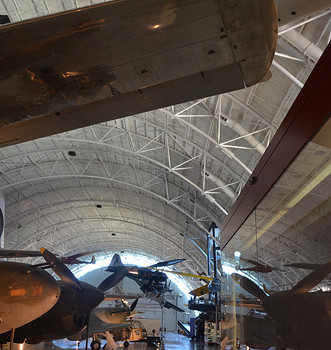
Steven F. Udvar-Hazy Center: B-29 Superfortress “Enola Gay” panorama
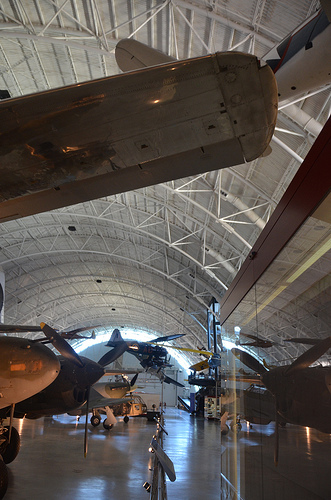
Image by Chris Devers
Quoting Smithsonian National Air and Space Museum | Lockheed P-38J-ten-LO Lightning :
In the P-38 Lockheed engineer Clarence "Kelly" Johnson and his team of designers developed a single of the most successful twin-engine fighters ever flown by any nation. From 1942 to 1945, U. S. Army Air Forces pilots flew P-38s more than Europe, the Mediterranean, and the Pacific, and from the frozen Aleutian Islands to the sun-baked deserts of North Africa. Lightning pilots in the Pacific theater downed a lot more Japanese aircraft than pilots flying any other Allied warplane.
Maj. Richard I. Bong, America’s leading fighter ace, flew this P-38J-10-LO on April 16, 1945, at Wright Field, Ohio, to evaluate an experimental technique of interconnecting the movement of the throttle and propeller handle levers. Nonetheless, his appropriate engine exploded in flight before he could conduct the experiment.
Transferred from the United States Air Force.
Manufacturer:
Lockheed Aircraft Company
Date:
1943
Country of Origin:
United States of America
Dimensions:
General: 390 x 1170cm, 6345kg, 1580cm (12ft 9 9/16in. x 38ft 4 five/8in., 13988.2lb., 51ft 10 1/16in.)
Materials:
All-metal
Physical Description:
Twin-tail boom and twin-engine fighter tricycle landing gear.
• • • • •
Quoting Smithsonian National Air and Space Museum | Boeing B-29 Superfortress "Enola Gay":
Boeing’s B-29 Superfortress was the most sophisticated propeller-driven bomber of Globe War II and the first bomber to home its crew in pressurized compartments. Even though developed to fight in the European theater, the B-29 discovered its niche on the other side of the globe. In the Pacific, B-29s delivered a assortment of aerial weapons: standard bombs, incendiary bombs, mines, and two nuclear weapons.
On August 6, 1945, this Martin-constructed B-29-45-MO dropped the 1st atomic weapon employed in combat on Hiroshima, Japan. 3 days later, Bockscar (on show at the U.S. Air Force Museum near Dayton, Ohio) dropped a second atomic bomb on Nagasaki, Japan. Enola Gay flew as the advance weather reconnaissance aircraft that day. A third B-29, The Wonderful Artiste, flew as an observation aircraft on both missions.
Transferred from the United States Air Force.
Manufacturer:
Boeing Aircraft Co.
Martin Co., Omaha, Nebr.
Date:
1945
Country of Origin:
United States of America
Dimensions:
General: 900 x 3020cm, 32580kg, 4300cm (29ft 6 5/16in. x 99ft 1in., 71825.9lb., 141ft 15/16in.)
Materials:
Polished overall aluminum finish
Physical Description:
Four-engine heavy bomber with semi-monoqoque fuselage and higher-aspect ratio wings. Polished aluminum finish overall, regular late-Planet War II Army Air Forces insignia on wings and aft fuselage and serial number on vertical fin 509th Composite Group markings painted in black "Enola Gay" in black, block letters on decrease left nose.